

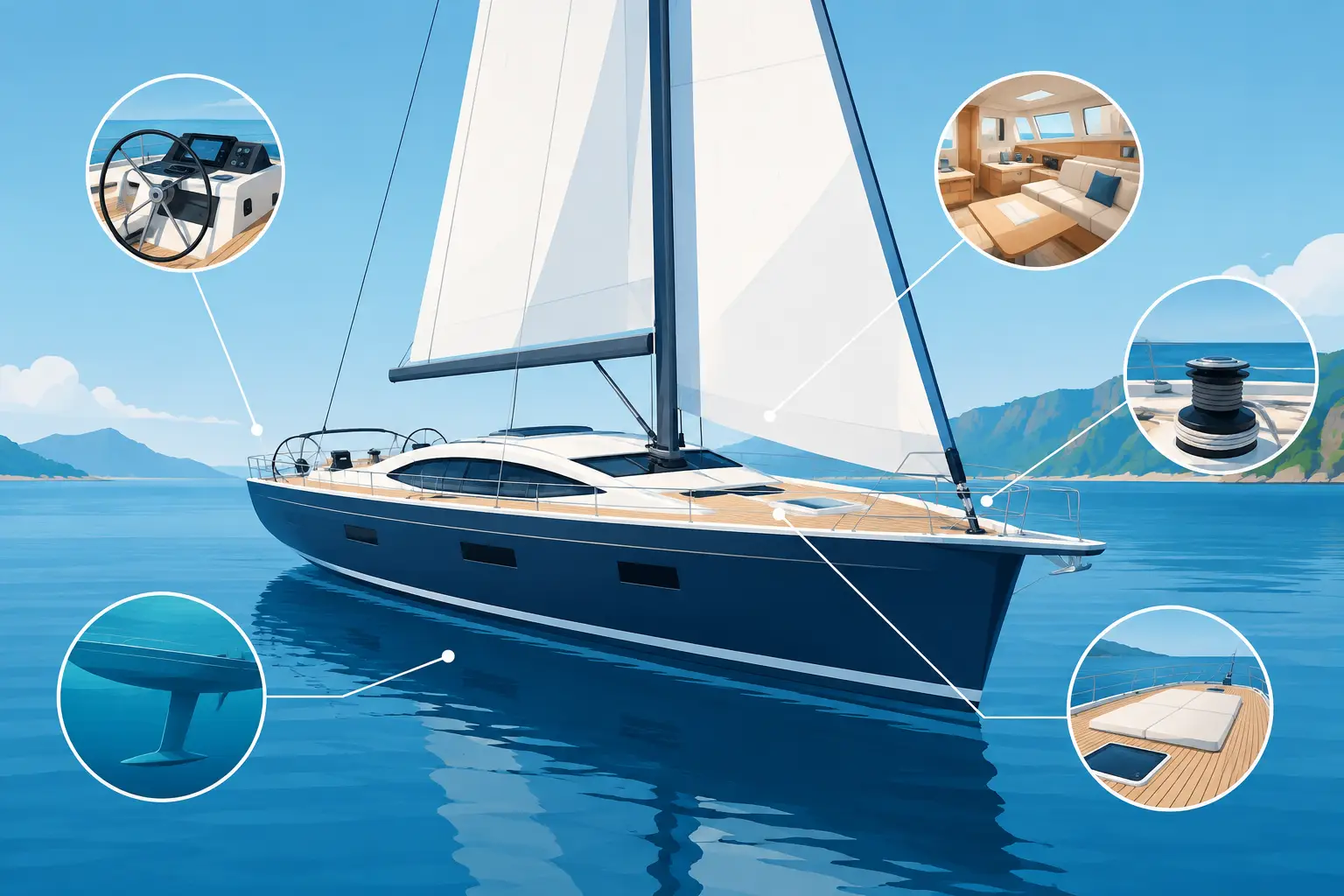
A sailing yacht can impress within minutes: a graceful sheer line, a well-kept teak deck, a bright saloon, and the quiet confidence of a vessel under sail. Yet the top sailing yacht features are not simply the most visible ones. For a serious buyer, the best features combine sailing pleasure, technical integrity, owner comfort, and credible long-term value.
In the pre-owned market, the question is rarely whether a yacht has desirable equipment. Most established yachts have been upgraded, modified, or personalized over time. The more meaningful question is whether her specifications, maintenance history, and layout work together as a coherent whole. A well-chosen sailing yacht should feel rewarding on passage, comfortable at anchor, manageable with the intended crew, and straightforward to own.
The Top Sailing Yacht Features Begin Below the Waterline
Hull construction and condition deserve attention before almost any cosmetic detail. Whether a yacht is built in aluminum, composite, steel, or wood, the material itself is only part of the story. Build quality, survey findings, maintenance discipline, and the vessel’s operating history determine the real picture.
A modern composite yacht may offer low weight, strong performance, and reduced routine maintenance, but buyers should review moisture readings, prior repairs, and the quality of any osmosis treatment. Aluminum remains highly regarded for expedition-minded and custom yachts because it permits strong, capable construction, though corrosion prevention and insulation details need careful examination. Steel can provide exceptional strength and volume on larger vessels, while requiring close attention to coatings and corrosion management. Classic wooden yachts have incomparable character, but ownership demands specialist care and a realistic maintenance budget.
The keel, rudder, shaft or saildrive arrangement, through-hulls, and hull-to-deck joint should be assessed with equal care. A recent haul-out report is valuable, but it does not replace an independent survey. On a yacht intended for Mediterranean cruising, a clean, properly maintained underwater body can influence performance, fuel use under power, and the cost of annual care.
A Rig Designed for the Way You Will Sail
The rig is both the yacht’s engine and one of its most consequential capital components. Standing rigging has a service life, and replacement costs can be significant, particularly on larger sloops, cutters, ketches, and performance cruisers with carbon spars. Documentation matters: buyers should establish the age of the wire or rod rigging, inspect terminals and chainplates, and confirm the service history of furlers, winches, hydraulic systems, and mast equipment.
The ideal sail plan depends on the owner’s ambitions. A short-handed owner may value electric or hydraulic in-mast furling, self-tacking headsails, captive winches, and clearly led control lines. These systems can make a substantial yacht more approachable for a family or a small professional crew. The trade-off is additional complexity and more systems to maintain.
For owners who prioritize performance, a conventional mast with a quality full-batten mainsail may offer better sail shape and easier repair options. Carbon spars and high-modulus rigging reduce weight aloft, improving stability and response, although they demand specialist inspection and come with a premium. Neither approach is universally superior. The right choice reflects how often the yacht will sail, who will operate her, and whether effortless cruising or more spirited passage-making takes priority.
Sail Inventory Is More Than an Inventory List
A yacht advertised with several sails may still require a substantial sail budget. Ask when each sail was built, who made it, how it has been stored, and whether it has been regularly serviced. A practical cruising inventory often includes a mainsail, furling genoa or jib, staysail where applicable, and a downwind sail suited to the yacht’s intended waters.
For East Mediterranean cruising, owners frequently appreciate a sail wardrobe that performs in light summer conditions while remaining manageable when the meltemi arrives. Properly specified sails, reliable reefing, and a balanced helm contribute more to confidence underway than an impressive but impractical racing inventory.
Deck Layout Should Support Safe, Relaxed Living
A beautiful deck arrangement should be judged underway, not only in harbor photographs. Wide side decks, well-positioned handholds, deep cockpit coamings, and logical access to sail controls improve safety for guests and crew. On a family-oriented yacht, secure movement from cockpit to foredeck is especially valuable when children or less experienced guests are aboard.
Cockpit design also shapes the social life of the yacht. A generous table, shade protection, comfortable seating, refrigeration, and easy water access transform time at anchor. A fixed bimini may provide excellent protection but can affect sightlines and aesthetics. A retractable or removable system offers flexibility, though it may provide less protection in sustained conditions.
A stern platform, folding transom, or tender garage is often among the most desirable features on contemporary sailing yachts. These elements create a more direct connection to the sea and simplify swimming, watersports, and tender transfers. Buyers should nevertheless check the mechanism, drainage, seals, and load capacity. On a well-equipped yacht, convenience should never compromise watertight integrity or easy service access.
Interior Volume Must Be Matched by Practical Design
A sailing yacht’s interior should feel considered rather than merely spacious. Natural light, headroom, quality joinery, ventilation, and sound insulation shape the onboard experience over long periods. On a yacht of 70 feet or more, the distinction between an owner-focused arrangement and a charter-oriented layout becomes particularly relevant.
A private owner may prefer a full-beam master suite, a dedicated study, generous wardrobe space, and discreet separation between guest and crew areas. A buyer planning charter use may prioritize equivalent guest cabins, en suite facilities, flexible berths, and a galley capable of supporting a professional chef. Both can be successful, but each choice affects resale appeal to different buyer groups.
The galley is worth close inspection. Equipment from respected manufacturers is appealing, yet layout and storage are often more important. Look for secure work surfaces, reliable refrigeration, dry stores, sensible ventilation, and access for servicing appliances. At sea, a galley must remain safe and functional, not simply attractive at a dockside viewing.
Air conditioning, heating, watermakers, stabilizing systems where fitted, and generators can broaden a yacht’s cruising range and comfort. They also introduce operating costs, noise considerations, and maintenance obligations. In warm Mediterranean climates, well-planned air conditioning and adequate battery capacity may be more valuable than an oversized generator that is rarely used efficiently.
Engineering Access and Energy Independence Matter
Among the most overlooked top sailing yacht features is access. A yacht may carry excellent machinery, but if pumps, filters, valves, batteries, and chargers are difficult to reach, routine care becomes slower and more expensive. A clean engine room with labeled systems, proper lighting, sound insulation, and orderly plumbing says much about prior stewardship.
Review the main engine hours alongside service records, not in isolation. A lightly used engine that has sat for years can require more attention than one that has been regularly exercised and serviced. The same principle applies to generators, bow thrusters, air conditioning compressors, and hydraulic equipment.
Energy management is increasingly central to modern ownership. Lithium battery banks, solar panels, high-output alternators, smart chargers, and inverters can reduce generator dependence and make extended anchoring more comfortable. However, retrofitted electrical systems should be inspected for design quality, charging compatibility, ventilation, and documentation. Sophisticated equipment without clear installation records deserves caution.
Navigation and Communications Should Be Current, Not Crowded
A clean, integrated bridge arrangement helps the skipper make better decisions. Modern chartplotters, radar, AIS, autopilot, depth sounders, cameras, and satellite communications can materially improve safety and usability. The best installations are intuitive, properly networked, and supported by manuals and service records.
Technology dates quickly, so buyers should avoid placing too much value on a long list of aging electronics. A yacht with an orderly helm, recent core equipment, and sensible redundancy can be more attractive than one with multiple legacy screens and unsupported systems. For offshore aspirations, reliable communications, emergency equipment, and redundant navigation capability deserve special attention.
Refit History Can Be a Stronger Signal Than Launch Year
A substantial refit, completed to a high standard and documented in detail, can materially enhance a pre-owned sailing yacht. It may include new rigging, sails, paintwork, teak decks, machinery rebuilds, electrical upgrades, interiors, and navigation equipment. Yet the term “refit” covers a wide range of work. Buyers should request invoices, specifications, dates, warranties, and the identity of the shipyard or contractors involved.
The most persuasive refit history shows a pattern of thoughtful ownership rather than isolated spending before a sale. Recent works should align with survey findings and with the yacht’s stated asking price. A tailored technical review, supported by an experienced broker, surveyor, and where appropriate a captain or project manager, helps distinguish genuine value from a costly deferred-maintenance list.
Choose Features That Protect the Ownership Experience
The right yacht is not necessarily the one with the longest specification sheet. It is the yacht whose features serve a clear purpose: a rig that suits the crew, systems that can be maintained confidently, spaces that fit the owner’s life, and a documented history that supports both enjoyment and resale.
For buyers considering a significant acquisition, discreet, professional guidance can bring order to that assessment. AlphaOceanic approaches each sailing yacht search with the same attention given to the transaction itself – understanding the client’s cruising plans first, then evaluating the vessel behind the presentation. A considered inspection and an honest technical conversation before an offer can protect years of pleasurable ownership.