

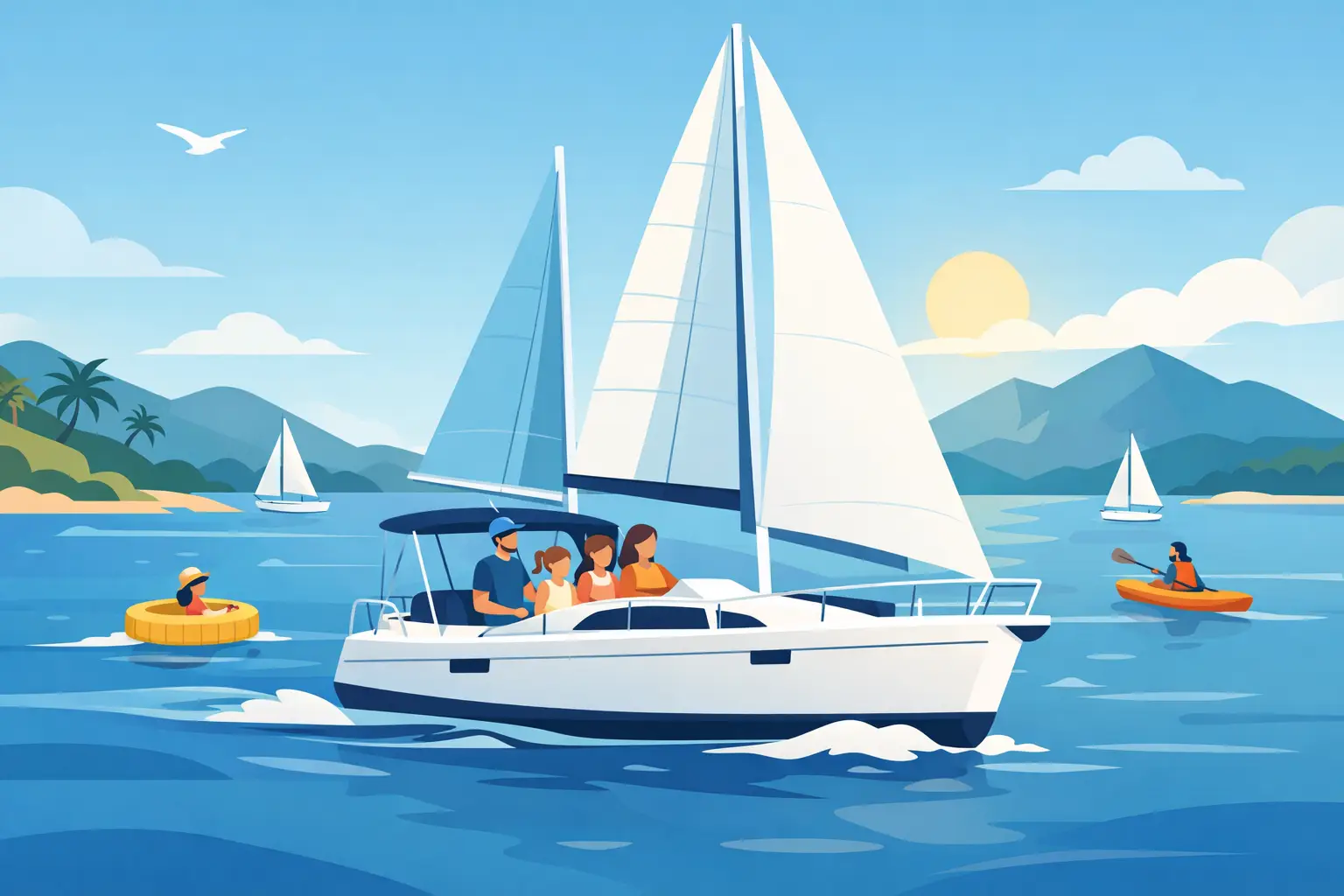
A family yacht is tested at breakfast in a crowded anchorage, not only during a quiet sea trial. The best sailing yachts for families make room for changing routines: children who want to swim before lunch, teenagers who need privacy, guests arriving for a weekend, and owners who still expect a rewarding day under sail. For buyers considering the East Mediterranean and beyond, the right choice is rarely the most elaborate yacht available. It is the yacht whose layout, systems, and sailing character remain easy to live with over many seasons.
A successful purchase begins with an honest view of how the yacht will be used. A couple with young children cruising the Greek islands has different requirements from a multigenerational family planning longer passages to Italy, Croatia, or the Caribbean. Length, hull configuration, crew support, and the number of nights spent aboard all affect the decision.
What Makes the Best Sailing Yachts for Families
The strongest family sailing yachts balance three qualities that can compete with one another: safe movement around the yacht, private and comfortable accommodation, and manageable sailing performance. A yacht may offer spectacular volume, for example, but be less engaging under sail or more demanding to berth in a compact marina. A lighter performance cruiser may reward an experienced owner at the helm, yet offer less storage for water toys, provisions, and the practical equipment family cruising requires.
For many owners, the most attractive range begins around 45 feet and extends to approximately 60 feet. Below this range, a family of five or six can quickly feel constrained on longer holidays. Above it, space is exceptional, but operating costs, crew expectations, berth availability, and maintenance planning rise materially. There are exceptions, particularly for owners who use professional crew or who value a large owner’s suite and separate guest zones.
The ideal yacht should not merely sleep the family. It should allow everyone to enjoy time aboard without turning daily life into a series of compromises.
A Layout That Separates Activity From Rest
Cabin count matters, but the arrangement matters more. A three-cabin yacht with a generous owner’s cabin, two equal guest cabins, and two well-positioned heads can be more successful than a four-cabin layout with narrow berths and limited stowage. For families with younger children, cabins close to the owner’s cabin offer reassurance. Families with older children or regular guests often prefer separation, with the owner’s accommodation forward and guest cabins aft, or vice versa.
A proper galley is equally valuable. On a yacht used for extended cruising, it needs secure handholds, refrigeration capacity, deep lockers, and enough counter space for real meal preparation. The social appeal of an open galley and saloon is undeniable, though a semi-separated galley can keep heat, noise, and clutter away from the main living area.
Look closely at the cockpit. It should accommodate an outdoor lunch for the entire family, offer clear sightlines to the water, and provide a protected place for children during a passage. A hardtop, bimini, and effective side shade are not minor conveniences in the Mediterranean summer. They often determine how comfortably the yacht is used from morning through late afternoon.
Safety That Supports Independence
Children gain confidence afloat when the yacht is designed for safe independence. Deep, well-protected cockpits, high lifelines, sturdy pulpits, secure companionway access, and wide side decks all deserve close attention. So do the smaller details: non-slip surfaces that remain effective when wet, handholds positioned at the right height, and gates that can be secured properly.
A center cockpit can provide excellent protection and a clear division between social areas and working areas. An aft cockpit, meanwhile, may connect more naturally to the swim platform and create a relaxed indoor-outdoor flow at anchor. Neither is universally superior. The right configuration depends on whether the yacht will spend more time sailing passages, entertaining at anchor, or operating with crew.
A family buyer should also inspect the tender arrangement with care. A dinghy is often the real family vehicle once the yacht is anchored. Davits, a hydraulic platform, or a dedicated garage can make launch and recovery straightforward. However, these systems add weight, complexity, and service requirements. The best solution is the one the owner and crew will use confidently every day.
Monohull or Catamaran?
This is usually the central decision for buyers seeking the best sailing yachts for families. A modern cruising catamaran offers remarkable living space, stable anchoring, a broad cockpit, and cabins that can feel comparable to those on a small waterfront residence. The shallow draft is especially appealing in the Greek islands, where a closer approach to certain coves can transform the cruising experience.
The trade-off is that catamarans require wider berths, can command higher marina fees, and may not offer the same sailing feel as a well-designed monohull. Their bridge-deck clearance, load carrying, and sailing behavior in certain sea states should be assessed seriously rather than assumed. A heavily loaded catamaran can lose much of the performance that made it attractive in the first place.
A monohull remains an elegant choice for families who value the rhythm of sailing, easy marina access, and a more traditional yacht profile. Modern hull forms and beamier designs have greatly improved interior volume, particularly in the 50- to 60-foot range. A deck saloon monohull can also deliver excellent visibility and natural light while retaining the refined motion and handling many experienced owners prefer.
For a family that plans to spend long periods at anchor with several guests, a catamaran often has the advantage. For an owner who wants to sail regularly, visit a wider range of marinas, and retain a classic sense of connection to the sea, the right monohull may be more compelling.
Equipment That Reduces Friction Aboard
A well-specified family yacht protects time. Air conditioning and a capable generator may be essential for owners who cruise in peak summer, while lithium battery banks, solar panels, and watermakers can extend autonomy at anchor. These systems should be evaluated as an integrated package. More equipment can mean greater comfort, but it also means more maintenance and a more demanding pre-purchase inspection.
For shorthanded operation, electric or hydraulic furling, powered winches, a bow thruster, and reliable autopilot integration can make a substantial difference. They do not replace proper seamanship, but they reduce the workload of leaving a berth or shortening sail when the family is enjoying lunch below deck.
Consider the yacht’s storage with the same discipline applied to its cabins. Paddleboards, snorkel gear, life jackets in multiple sizes, provisions, spare linens, and luggage all need accessible homes. Loose equipment is not only untidy. In rough conditions, it becomes a practical and safety concern.
Buy the Condition, Not Only the Model
A respected builder and a desirable model are valuable starting points, but condition determines the ownership experience. On a pre-owned sailing yacht, the standing rigging, sails, saildrive or shaft seals, engines, generator, batteries, electronics, deck hardware, and hull moisture history require professional review. A recent refit can be attractive, yet buyers should establish precisely what was renewed, by whom, and with what documentation.
The survey and sea trial are not procedural formalities. They are the point at which a yacht’s advertised lifestyle is tested against its underlying technical reality. A family yacht should be easy to own, and deferred maintenance has a way of taking attention away from the very time owners intended to spend with their families.
Resale should also inform the purchase. Neutral, well-maintained interiors, practical cabin configurations, recognized builders, documented upgrades, and sensible specifications typically broaden a yacht’s future buyer pool. Highly personalized alterations can be enjoyable for one owner while narrowing the market later.
At AlphaOceanic, this is where bespoke brokerage guidance is particularly valuable: matching a client’s family plans and preferred cruising grounds with a carefully assessed yacht, then managing the technical, commercial, and cross-border details with discretion.
The Right Yacht Should Grow With Your Family
It is tempting to buy for the children’s current ages, current hobbies, and one imagined summer itinerary. A more considered acquisition looks five to 10 years ahead. Young children become teenagers who bring friends. Weekends become longer passages. A yacht initially run entirely by its owners may later benefit from a skipper or seasonal crew.
The finest family sailing yacht is not defined by a single feature or a famous badge. It is the yacht that makes every member of the family feel there is a place for them aboard, while giving the owner confidence in its handling, condition, and long-term value. Choose with care, and the yacht becomes more than a beautiful asset. It becomes the setting for the family time that is hardest to recreate anywhere else.