

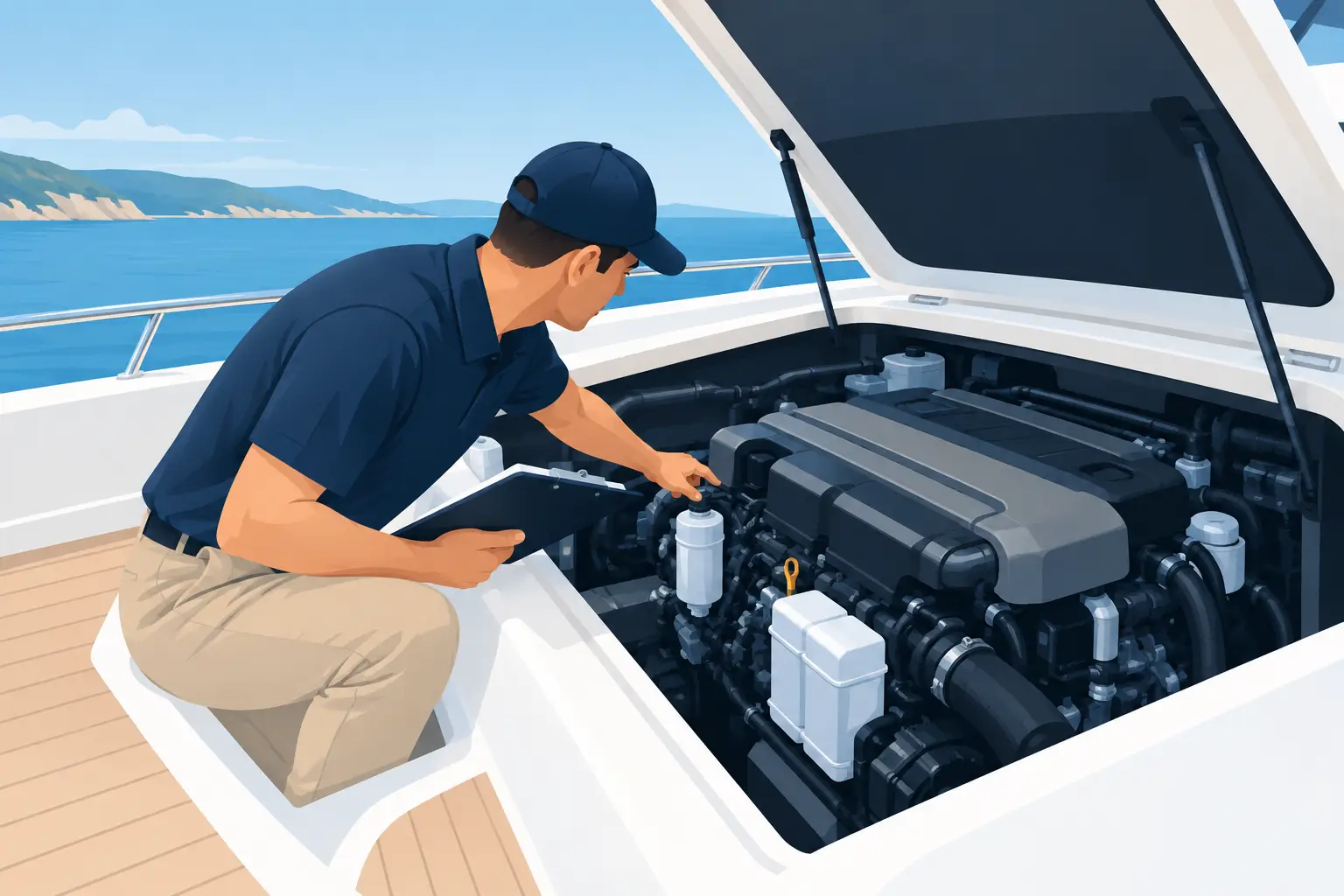
A yacht engine inspection is one of the few moments in a purchase process when a beautiful yacht becomes a measurable asset. Polished stainless steel, a recent paint job, and an inviting interior can make a powerful first impression. Yet the engine room often tells the more consequential story: how the vessel has been operated, maintained, upgraded, and prepared for her next owner.
For a pre-owned yacht buyer, machinery condition influences far more than the immediate cost of repairs. It affects cruising plans, insurance discussions, resale confidence, negotiating position, and the time required before the yacht can be enjoyed without reservation. A disciplined inspection does not assume that an older yacht is a poor choice or that a low-hour yacht is automatically exceptional. It establishes what is actually present, what requires attention, and what should be reflected in the purchase terms.
Why a Yacht Engine Inspection Deserves Special Attention
A main engine is a complex system rather than a single line item. Its condition is shaped by age, hours, load profile, service quality, ambient heat, fuel cleanliness, cooling-water conditions, and periods of inactivity. In the East Mediterranean, yachts may also spend extended periods in warm marinas, where insufficient use can be as revealing as heavy seasonal use.
A yacht with 3,000 carefully documented hours, consistent servicing, clean operating data, and a competent engine-room installation may represent a more assured acquisition than one with very low hours and incomplete records. Low use can mean corrosion, deteriorated hoses and seals, contaminated fuel, or deferred commissioning work. The correct interpretation always depends on the yacht, her machinery package, and the evidence available.
For buyers considering a substantial motor yacht, propulsion machinery is also inseparable from the broader onboard technical ecosystem. Generators, gearboxes, stabilizers, thrusters, shaft systems or pod drives, exhaust components, battery banks, chargers, and monitoring equipment all affect the reliability of the ownership experience. An engine inspection should therefore be viewed as part of a wider technical due diligence process, not as a brief look beneath the floorboards.
Begin With Records, Not the Engine Room
Before an engineer starts the engines, the documentation should be reviewed. Service invoices, engine-hour reports, oil-analysis records, warranty correspondence, refit specifications, and maintenance schedules create the timeline against which physical findings can be assessed.
The objective is not merely to confirm that invoices exist. A buyer should seek consistency. Do reported engine hours align with service intervals? Was the major manufacturer-recommended service completed when due? Are serial numbers correctly recorded? Have recurring alarms or cooling, fuel, or exhaust issues been addressed properly? A well-organized file is not proof of perfect mechanical condition, but it is often a strong indication of conscientious ownership.
Particular attention should be given to major scheduled work. Depending on the engine manufacturer and model, this may include valve adjustments, injector servicing, heat-exchanger cleaning, turbocharger attention, gearbox servicing, mount replacement, or comprehensive cooling-system work. If a costly service is approaching, that fact may be entirely acceptable, provided it is identified early and considered within the purchase negotiation.
Where maintenance has been completed by authorized dealers or respected marine engineers, the records can carry added weight. Even so, invoices should not replace independent evaluation. A buyer’s surveyor and machinery specialist must remain free to form their own opinion.
What a Qualified Engineer Should Examine
The engine-room inspection begins with access, cleanliness, and installation quality. A spotless engine room is welcome, but cosmetic order is not the same as technical care. An experienced engineer looks behind panels and beneath drip trays, checking whether the space allows safe servicing and whether leaks, corrosion, vibration damage, loose wiring, or neglected systems are being concealed by presentation.
The main engines should be inspected cold whenever possible. A cold start can reveal delayed starting, abnormal smoke, uneven idle, low oil pressure, or unusual mechanical noise that may be less apparent once operating temperature is reached. The engineer will review fluid levels and condition, inspect belts, hoses, clamps, mounts, filters, and cooling-water components, and look for evidence of oil, fuel, coolant, or exhaust leaks.
Electronic diagnostics are equally valuable on modern machinery. Downloading fault histories and operating data can identify past overheat events, over-speed conditions, sensor failures, or alarm patterns that are not evident during a short visit. Data must be interpreted carefully: an old fault code does not automatically signal an active problem, and a clean screen does not eliminate the need for physical inspection. Together, diagnostic data and firsthand observation provide a far more credible picture.
A thorough review extends to reduction gearboxes, drive shafts, couplings, seals, and engine mounts. On yachts equipped with pod drives, waterjets, or surface drives, the inspection requires relevant specialist knowledge and may include additional haul-out checks. The propulsion arrangement should never be treated as an afterthought simply because the engines themselves appear well maintained.
Generators and Supporting Systems Matter
Generators are frequently overlooked during a yacht purchase, despite carrying much of the daily load at anchor. Their hours, service history, sound shields, exhaust systems, mounts, cooling circuits, and ability to accept load should be assessed with the same care given to the main engines.
The inspection should also consider fuel tanks, filters, transfer pumps, fire-suppression systems, ventilation, bilge condition, and electrical installation. A yacht may run well at sea trial while still presenting meaningful risk through aging fuel hoses, poorly supported wiring, corrosion at battery connections, or inadequate access to emergency shutoffs. These details are rarely glamorous, but they matter greatly to safe ownership.
Sea Trial Is Where Findings Are Tested
A dockside inspection cannot replicate the demands of a sea trial. Once underway, the engineer can observe cold and warm running behavior, acceleration, vibration, steering response, exhaust appearance, temperature stability, oil pressure, charging performance, and the relationship between engine speed and vessel speed.
The engines should be brought through an appropriate range of RPM under meaningful load, subject to the captain’s operating guidance and the survey plan. A brief, cautious run around the harbor rarely provides enough information for a serious acquisition. Conversely, an aggressive trial without proper preparation is not responsible. The right protocol depends on the yacht’s age, machinery, recent use, and the engineer’s recommendations.
Performance figures should be compared with the builder’s expected data, while allowing for hull condition, fuel load, sea state, propeller condition, and the yacht’s current displacement. A yacht that falls short of published top speed does not necessarily have an engine problem. Fouling, incorrect propellers, or additional equipment weight may explain the difference. The important point is to investigate the cause rather than accept an assumption.
After the sea trial, the machinery should be checked again. Fresh leaks, elevated temperatures, loose connections, or signs of overheating can emerge only after the engines have been worked properly. This second review is one of the most useful stages of the entire process.
When Oil Analysis and Further Testing Are Appropriate
Oil analysis can offer a useful view into wear metals, contaminants, lubricant condition, and possible coolant or fuel intrusion. It is particularly worthwhile for larger yachts, older engines, high-hour machinery, or purchases where the history is incomplete. The sample must be taken correctly, preferably during the formal inspection, and interpreted by someone who understands the engine model and its service history.
A concerning result is not a verdict by itself. Elevated metals, for example, may warrant resampling, comparison with prior reports, or targeted investigation. Similarly, compression testing, borescope inspection, cooling-system pressure tests, thermal imaging, or vibration analysis may be recommended when symptoms justify a deeper review. These steps add time and cost, but they can be prudent when the financial exposure is substantial.
Turning Technical Findings Into a Better Purchase Decision
Most pre-purchase yacht engine inspections identify items that need attention. The question is whether those findings are routine, manageable, or material. A list of aged hoses, overdue filters, cosmetic corrosion, and ordinary commissioning work may be expected on a yacht that has been laid up. An unresolved overheat history, poor oil results, significant corrosion, inaccessible machinery, or a looming rebuild demands a different level of consideration.
The best purchase decisions separate condition from emotion. Findings can support a price adjustment, a seller-completed repair agreement, a retention arrangement, or a decision to step away. The appropriate route depends on the value of the yacht, the clarity of the remedy, the seller’s cooperation, and the buyer’s intended program. A yacht that needs work is not necessarily the wrong yacht, but its price and contract structure must recognize the work honestly.
At AlphaOceanic, the objective is to help clients approach each stage of a yacht acquisition with discretion, clarity, and the right professional support. A carefully managed technical review protects the pleasure of ownership before the first departure is planned.
The finest outcome is not an inspection report with no observations. It is the confidence of knowing the yacht’s machinery condition, the likely cost of ownership, and exactly what should happen next before commitments are finalized.