

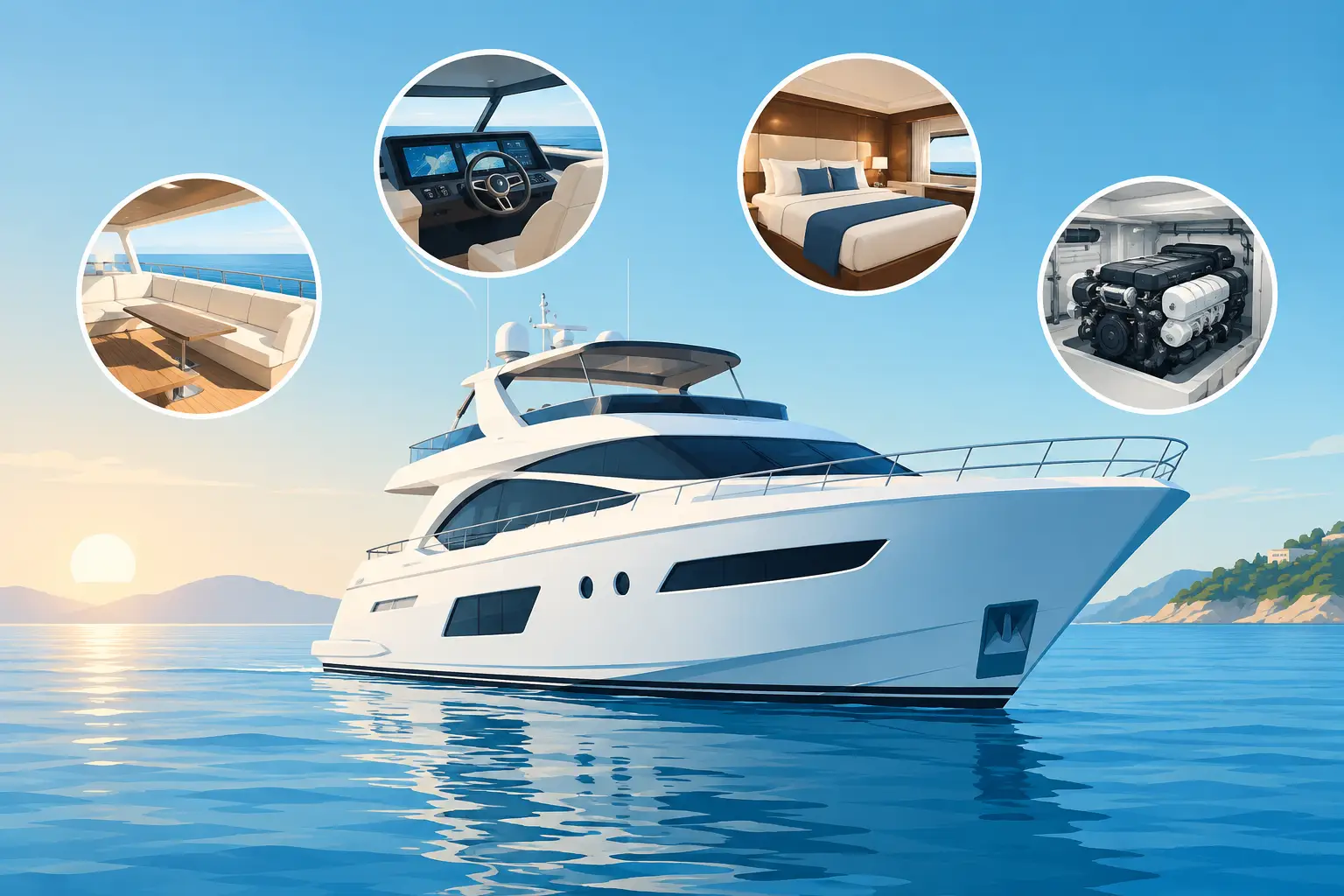
A pre-owned yacht reveals its quality long before the engines are started. It appears in the order of the engine room, the clarity of refit invoices, the condition of concealed systems, and the logic of the accommodation. The best features in used yachts are rarely the most photogenic additions. They are the features that protect time on the water, preserve value, and make ownership feel considered rather than demanding.
For a buyer considering a luxury motor yacht or sailing yacht in the East Mediterranean, the right vessel is not necessarily the newest or the most extensively equipped. It is the yacht whose specification, maintenance history, and cruising profile align with the owner’s intended use. A well-chosen brokerage yacht can offer proven design, mature engineering, and an exceptional level of equipment at a more compelling position than a new build. The distinction lies in knowing what deserves a premium and what merely looks impressive at first viewing.
Best Features in Used Yachts Begin Below Deck
A documented maintenance history is among the most valuable assets aboard a pre-owned yacht. Service records for main engines, generators, stabilizers, transmissions, watermakers, air conditioning, and hydraulic systems provide a far clearer picture than a spotless exterior alone. Consistent records also show how the previous owner approached stewardship: whether maintenance was preventative, whether recommendations were acted upon, and whether major costs have been deferred.
Look for invoices that identify engine hours, dates, scope of work, parts replaced, and the servicing contractor. A complete file should also address annual haul-outs, antifouling, shaft and propeller work, battery replacement, safety-equipment servicing, and class or flag-state requirements where applicable. Electronic records are welcome, but a well-organized physical history file often tells a more complete story.
There is a trade-off. A yacht with an extensive record of recent work may carry a stronger asking price, but that premium can be sensible if the work has been performed by respected specialists and verified during due diligence. Conversely, an attractively priced yacht with incomplete documentation may still be an opportunity, provided the buyer budgets for a more intensive survey and a realistic post-purchase program.
Machinery That Has Been Used and Properly Cared For
Low engine hours are not automatically a virtue. Marine machinery benefits from regular, correct use, particularly when supported by scheduled servicing and proper load management. A yacht that has been idle for long periods can develop issues with seals, fuel systems, batteries, cooling circuits, and electronics. Hours must be read alongside maintenance records, operational history, and the results of engine diagnostics.
The most reassuring machinery spaces are dry, accessible, clean without being artificially over-detailed, and arranged so that routine service can be performed without dismantling the yacht. Inspect the condition of insulation, hoses, clamps, filters, bilges, electrical panels, and fire-suppression systems. Evidence of disciplined engineering management is often more meaningful than polished paintwork.
For long-range cruising, stabilizers deserve particular attention. Zero-speed stabilization is highly valued by owners who spend substantial time at anchor in bays and island harbors. It improves comfort for guests and can materially enhance charter appeal. Yet stabilizer systems are sophisticated, and their service history, fin seals, hydraulic components, and control systems require careful review.
A Layout That Still Fits How Owners Live Aboard
A successful yacht layout is one of the few qualities that cannot be added economically after purchase. It shapes every day aboard: privacy between owner and guests, crew efficiency, access to the water, and the ease of entertaining. On a 75-foot motor yacht, a full-beam master suite may be more valuable to a family owner than an additional occasional cabin. On a sailing yacht, protected cockpit seating and practical deck circulation may matter more than a formal interior dining area.
The strongest pre-owned yachts separate guest enjoyment from operational activity. Guests should be able to move naturally between saloon, exterior dining, sun deck, and swim platform without crossing crew service routes or squeezing through narrow passages. Owners considering Mediterranean use should examine shade carefully. Fixed hardtops, deep overhangs, retractable awnings, and properly designed aft-deck coverage can make a meaningful difference during high summer.
Crew quarters merit an honest assessment, even for yachts that will be privately operated at times. Adequate crew accommodation, laundry capacity, galley workflow, storage, and technical access contribute directly to service standards and vessel condition. A yacht built for professional operation generally wears better over time than one that asks too much of limited crew space and systems.
Exterior Features With Lasting Value
The beach club, swim platform, and tender arrangement should be assessed as a complete operating area rather than as individual selling points. A hydraulic swim platform is appealing, but buyers should confirm its lifting capacity, service history, operating controls, and suitability for the tender they expect to carry. A garage that accommodates a tender neatly on paper may be inconvenient in daily use if launching requires extensive preparation.
A proper passerelle is particularly useful for Mediterranean stern-to mooring. So are secure boarding gates, well-positioned handrails, deck lighting, and non-slip surfaces in high-traffic areas. These details may seem modest during a brochure review, but they influence safety and comfort every time the yacht enters port.
Watersports equipment adds genuine lifestyle value when it is current, serviceable, and thoughtfully stored. However, an inventory of aging toys should not be valued as though it were new. Confirm the condition of personal watercraft, compressors, dive equipment, paddleboards, seabobs, and associated chargers. Storage volume, charging capability, and tender access matter as much as the equipment itself.
Meaningful Refits Versus Cosmetic Updates
A well-executed refit can transform a yacht and extend its ownership appeal for years. The most valuable refits address systems and structure before décor. Major machinery overhauls, generator replacements, new navigation suites, updated AV and communications systems, refreshed air conditioning, new teak where necessary, and revised electrical infrastructure can materially improve reliability and usability.
Interior updates can also be worthwhile when they are restrained and professionally integrated. Fresh upholstery, updated carpets, improved lighting, and renewed stone or wood finishes may bring an older yacht into a more contemporary market position. The question is whether the work supports the yacht’s original character and construction quality. Fashionable finishes applied without attention to joinery, ventilation, weight, or access panels can create future complications.
Buyers should ask for a detailed refit schedule, not simply a statement that the yacht has been “refitted.” Dates, contractors, warranties, technical specifications, and cost categories establish what was truly accomplished. A 2024 paint job and new cushions are not equivalent to a refit that includes engines, electronics, plumbing, and safety systems.
Navigation, Connectivity, and Safety Systems
Modern electronics can make an established yacht far easier to own, especially for owners who cruise across national borders or operate with family aboard. Current multifunction displays, radar, AIS, autopilot, GPS, depth sounders, cameras, and integrated monitoring systems improve situational awareness and reduce operating friction. Redundancy matters too. Independent navigation backups and manual overrides remain desirable on serious cruising yachts.
Connectivity is now part of the practical specification. Reliable onboard internet supports remote work, guest entertainment, route planning, and communication with management teams. The correct solution depends on cruising areas, vessel size, and anticipated demand. A system designed for occasional email and weather updates is different from one supporting several guests streaming content while crew manage operational systems.
Safety equipment should never be treated as a checklist exercise. Inspect life rafts, EPIRBs, firefighting equipment, fixed suppression systems, bilge alarms, emergency pumps, life jackets, and medical kits for dates, certification, accessibility, and suitability for the yacht’s operating area. Surveyors will assess these items formally, but a buyer should regard them as evidence of the vessel’s wider care standard.
The Features That Protect Resale Value
Proven shipyard pedigree remains one of the most durable advantages in the brokerage market. A yacht from a respected builder, with a recognizable design language and dependable technical support, typically attracts a broader future buyer pool. Build quality, model reputation, sensible displacement, efficient performance, and a layout that suits multiple ownership profiles all strengthen resale prospects.
Flag, tax status, compliance documentation, and charter capability may also affect value, although their relevance depends on the buyer’s plans. A yacht prepared for commercial operation can be attractive, but commercial compliance brings additional obligations and should not be assumed to suit every private owner. Similarly, a highly personalized layout may be perfect for one family and restrictive for the next.
At AlphaOceanic, the most productive viewing process starts with a precise brief rather than a broad search. When a buyer defines preferred cruising grounds, guest count, crew expectations, ownership horizon, and tolerance for refit work, the features that matter become easier to identify and compare.
A yacht should feel exceptional at anchor, but it should also stand up to the quieter test of ownership: routine service, a sudden weather change, a full guest itinerary, and a future sale. The vessel that has been intelligently maintained and properly specified will continue to reward its owner long after the first impression has passed.