

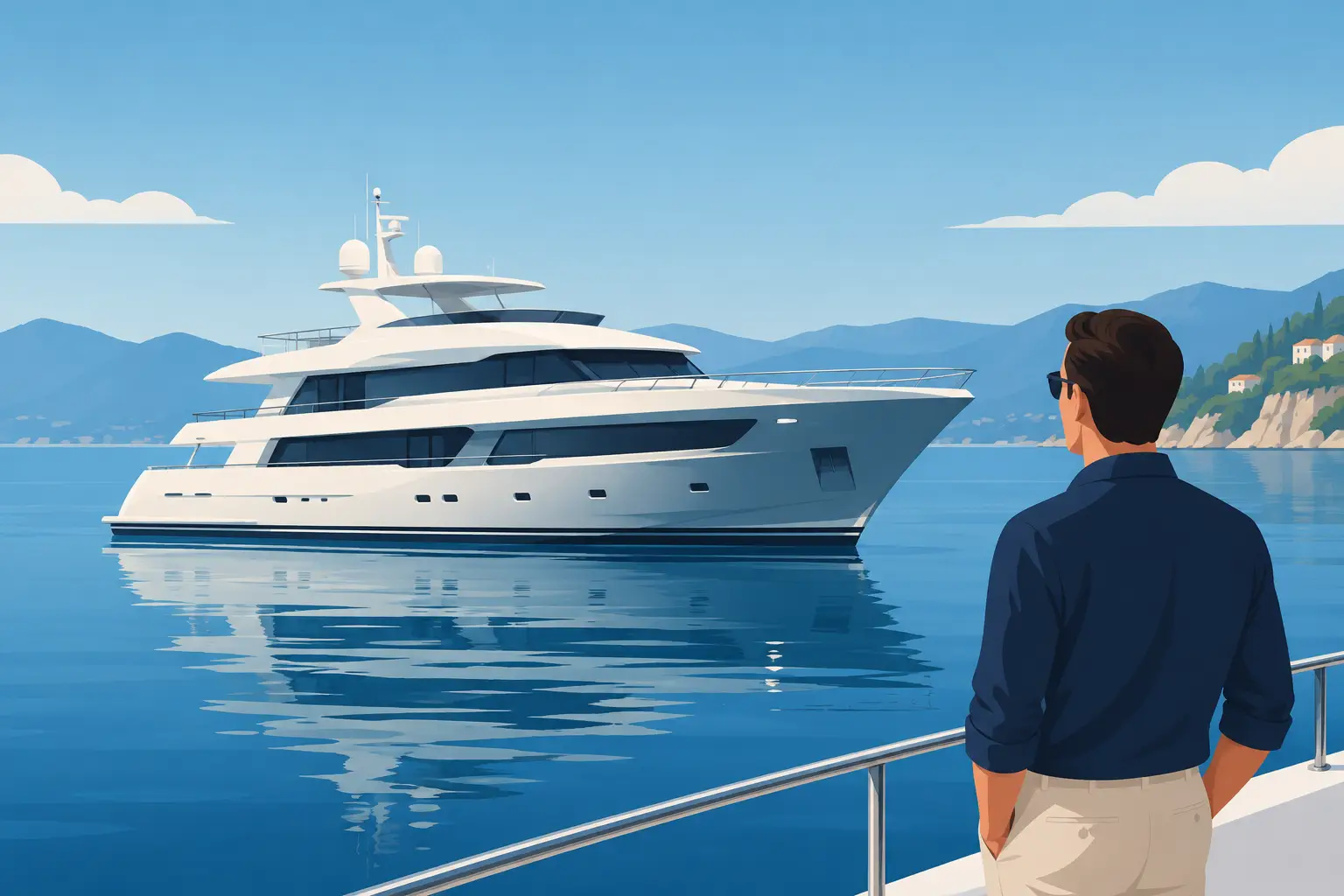
A displacement yacht makes its case long before the engines are started. The feeling is in the weight of the vessel underfoot, the quiet rhythm at sea, and the confidence that comes from a hull designed to carry owners, guests, provisions, and fuel across meaningful distances. For buyers considering the best displacement yachts, the central question is rarely which yacht posts the highest top speed. It is which yacht will deliver the right combination of range, comfort, engineering integrity, and ownership practicality.
For an owner planning extended Mediterranean seasons, Atlantic crossings, or private family cruising beyond crowded marinas, a well-chosen displacement yacht can be one of the most rewarding acquisitions in the pre-owned market. Yet the category is broad. A classic full-displacement motor yacht, a steel explorer, and a contemporary long-range cruiser may share a low-speed operating profile while offering very different ownership experiences.
What Defines the Best Displacement Yachts?
A true displacement hull moves through the water rather than attempting to plane over it. Its speed is principally governed by hull length and hydrodynamic efficiency, which means it is typically optimized for economical cruising rather than rapid passages. Most operate comfortably in the 8 to 12-knot range, although individual designs vary.
That restraint is not a compromise for the right owner. At displacement speeds, fuel consumption can be substantially more predictable, range can be exceptional, and motion at sea is generally more composed than in lighter, faster yachts. The yacht also tends to offer greater volume for its length, with room for generous machinery spaces, storage, crew quarters, technical redundancies, and owner-focused accommodation.
The best examples are designed around a coherent brief. They do not simply pair a heavy hull with modest engines. Naval architecture, tankage, stabilization, insulation, ventilation, machinery access, and weight distribution must all work together. A yacht advertised as long-range should be assessed by its realistic range at normal load, not by an optimistic brochure figure achieved with minimal fuel, no tenders, and ideal conditions.
Full Displacement or Semi-Displacement?
This is often the first technical distinction a buyer should make. A full-displacement yacht is purpose-built for efficient, steady cruising at lower speeds. It is the natural choice for owners who value ocean capability, low-stress passages, and time aboard as much as arrival times.
A semi-displacement yacht has a different proposition. It may offer a more flexible cruising profile and higher maximum speed, often in the mid-teens or beyond, while retaining meaningful range and substantial internal volume. For many Mediterranean owners, this can be the more versatile answer: efficient enough for longer passages, yet quick enough to make a weather window, reach a preferred anchorage, or accommodate a tighter itinerary.
Neither is inherently superior. A full-displacement yacht rewards patience and serious cruising ambitions. A semi-displacement yacht may better suit an owner who divides time between the East Mediterranean, the Caribbean, and shorter coastal programs. The key is to avoid buying a hull form that conflicts with the way the yacht will actually be used.
Range Is More Than a Fuel Figure
Range is one of the most attractive promises in displacement-yacht ownership, but it deserves careful interpretation. The published number should lead to further questions: At what speed was it calculated? Does it include a reserve? What generator load was assumed? Was the yacht carrying tenders, water toys, guests, and full stores?
Fuel capacity matters, but so does fuel management. Long-range yachts benefit from well-designed transfer systems, day tanks, filtration, polishing capability, and easily accessible inspection points. For a vessel intended to cruise beyond the usual service hubs, engineering self-sufficiency is not a luxury feature. It is part of safe, relaxed ownership.
Water capacity, desalination output, refrigeration volume, cold storage, and waste-treatment arrangements also affect genuine autonomy. A yacht capable of traveling 3,000 nautical miles on paper may still feel operationally limited if her domestic systems cannot support the guests and crew aboard for extended periods.
The Qualities That Matter on a Pre-Owned Yacht
In the brokerage market, the best displacement yacht is often not the newest or most decorated vessel. It is the yacht with a proven platform, clear maintenance history, sensible upgrades, and an ownership record that demonstrates consistent care.
Build material deserves close attention. Steel is particularly appealing for expedition-oriented yachts because of its strength, reparability, and suitability for substantial displacement designs. It also requires disciplined corrosion management, coating maintenance, and regular inspection of tanks, bilges, and inaccessible voids. Aluminum can reduce weight and provide excellent construction possibilities, but demands informed attention to insulation, galvanic protection, and paint condition. Composite construction may offer lower maintenance in certain areas and good efficiency, depending on the builder and design.
The engine room should be evaluated with as much care as the main salon. Look beyond presentation. Are systems clearly labeled? Is there adequate access around main engines, generators, pumps, and stabilizer components? Are service records detailed and credible? A clean machinery space is encouraging, but documented maintenance, competent installation work, and survey findings matter more.
A buyer should also investigate the age and condition of major equipment. Stabilizers, thrusters, air-conditioning plants, generators, electronics, watermakers, exhaust systems, and battery banks can carry meaningful replacement costs. Recent refits add value when they address the yacht’s underlying systems rather than only refreshing soft furnishings and exterior teak.
Comfort at Sea Is the Real Luxury
A displacement yacht should be judged while underway whenever possible. Dockside volume is appealing, but a sea trial reveals the quality of the experience that cannot be seen in photographs.
Pay attention to noise and vibration in the owner’s suite, guest cabins, wheelhouse, and main deck. Consider how the yacht handles beam seas and whether the stabilizer system is effective both underway and at anchor. Check sightlines from the helm, the practical usability of side decks, and the movement between galley, crew areas, and guest spaces.
For private ownership, layout is more consequential than a dramatic interior reveal. A family may prioritize a full-beam main-deck owner’s suite, flexible children’s cabins, and a protected aft deck. An owner who entertains frequently may prefer formal dining, a sky lounge, and a separate crew circulation route. A yacht intended for quiet cruising with a small team may benefit more from a compact, efficient crew arrangement than from cabins that appear impressive but add unnecessary operational complexity.
A Focused Purchase Process Protects the Investment
Displacement yachts are often sophisticated assets with decades of engineering evolution behind them. The purchase process should reflect that complexity. A thoughtful review normally includes an independent condition survey, machinery survey, sea trial, title and registration review, and a disciplined assessment of likely post-purchase works.
Before making an offer, establish the ownership brief in practical terms. Consider these five areas:
- Intended cruising grounds and annual mileage
- Preferred cruising speed and passage-making expectations
- Guest capacity, crew model, and privacy requirements
- Appetite for refit work and ongoing technical involvement
- Target annual operating budget, including reserve allowances
This exercise prevents a common mistake: acquiring a yacht for an imagined expedition program when the actual use will be relaxed summer cruising from Athens through the Cyclades, Ionian, and wider East Mediterranean. Conversely, an owner with genuine bluewater plans should not compromise on tankage, redundancy, crew capability, and seakeeping merely for a more fashionable interior.
Valuation also requires context. Two outwardly similar yachts can differ materially in value because of pedigree, refit quality, machinery hours, class status, VAT position, flag, crew standards, and the availability of complete technical records. A lower asking price may represent an opportunity, but it may equally reflect overdue capital expenditure that will quickly exceed the apparent saving.
Choosing a Yacht That Will Still Suit You at Sea
The finest displacement yachts are not defined by one specification sheet. They are vessels whose design, condition, and operating profile align with the owner’s real ambitions. The right yacht may be a refined Dutch-built cruiser, a proven steel explorer, a classic motor yacht with an exceptional refit, or a modern semi-displacement platform built for flexible Mediterranean use.
At AlphaOceanic, the role of a trusted broker is to make that distinction clear before negotiations begin: matching the yacht not only to a budget, but to the private life, cruising plans, and long-term expectations behind the purchase. The most satisfying yacht is the one that makes every mile feel considered, capable, and entirely your own.