

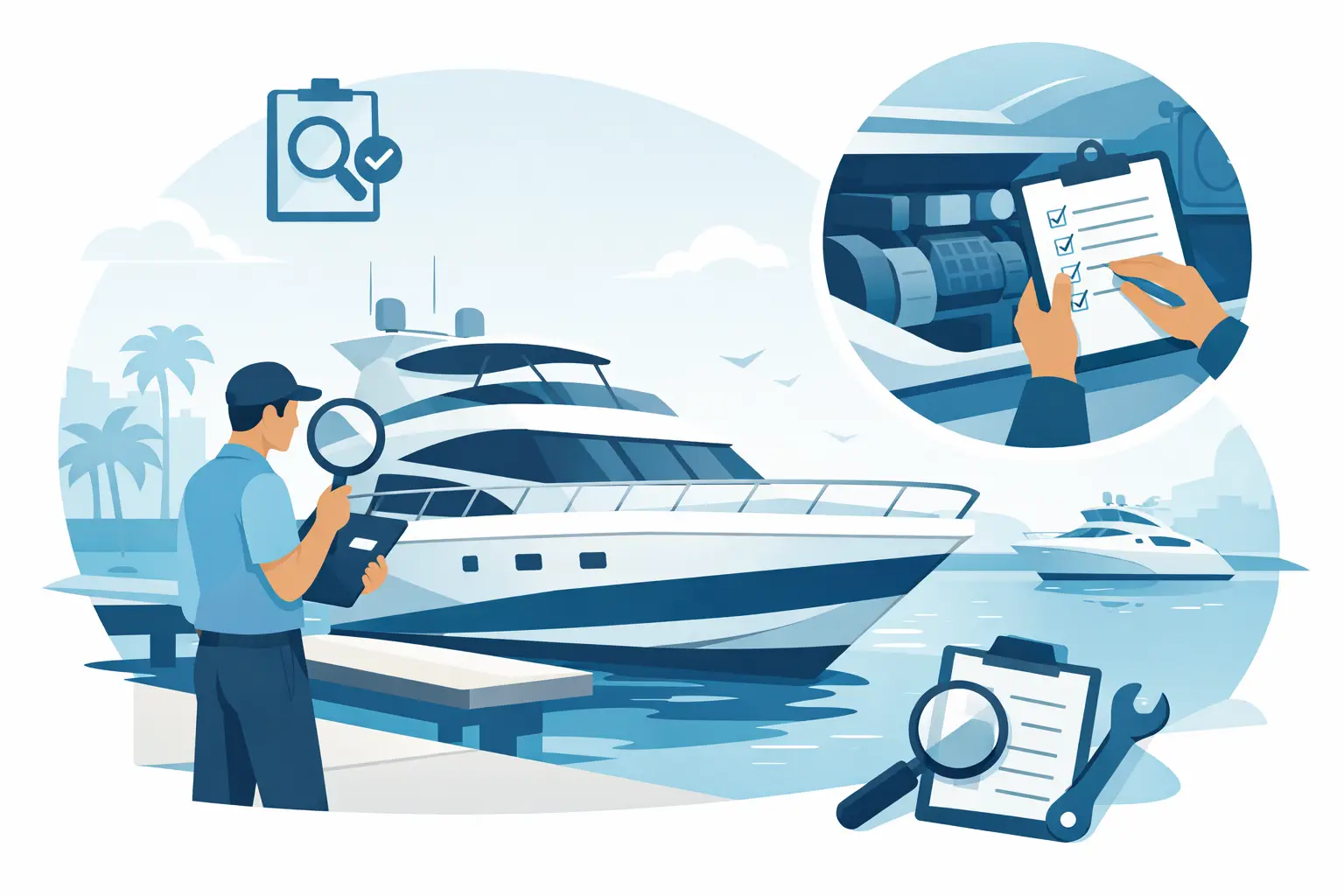
A polished profile, fresh photos, and a well-staged viewing can make any brokerage yacht look compelling. The real question is what the vessel reveals when appearances give way to technical scrutiny. A proper yacht inspection before purchase is where emotion meets evidence, and for any serious buyer of a pre-owned motor yacht or sailing yacht, that moment matters far more than the first impression.
In the luxury yacht market, inspection is not a formality. It is a decision-making process that protects capital, clarifies condition, and shapes negotiation. A yacht may be beautifully maintained in visible areas yet still carry deferred mechanical work, hidden moisture, outdated safety systems, or documentation gaps that affect both usability and long-term value. The larger and more sophisticated the yacht, the more important it becomes to evaluate not only what is present, but how well it has been managed.
What a yacht inspection before purchase is really meant to do
Buyers sometimes treat inspection as a pass-fail exercise. In practice, it is more nuanced. The objective is not simply to confirm whether a yacht is “good” or “bad.” It is to establish a clear picture of current condition, probable future expenditure, operational reliability, and whether the asking price aligns with reality.
That distinction matters. Many excellent yachts require remedial work. Equally, a yacht with a clean cosmetic presentation may prove to be a poor acquisition once structural, engineering, or maintenance findings are considered. A sound inspection process gives the buyer leverage, perspective, and a realistic understanding of ownership from day one.
For experienced owners and investors, this is also about asset discipline. A well-bought yacht is rarely just the one with the lowest accepted offer. It is the one acquired with a full understanding of condition, service history, and near-term capital requirements.
The three layers of pre-purchase evaluation
A yacht inspection before purchase usually unfolds in three connected layers: document review, physical survey, and sea trial. Each serves a different purpose, and none should be skipped simply because the yacht comes from a respected builder or appears to have had attentive ownership.
Document review
Before anyone starts lifting sole boards or testing machinery, the paperwork deserves close attention. Maintenance records, refit invoices, class status where applicable, registration, title chain, VAT position, engine hours, generator service intervals, and equipment manuals can reveal as much as the vessel itself.
A complete and orderly file usually suggests disciplined ownership. A fragmented file does not automatically mean the yacht has been neglected, but it does raise questions. Missing documentation can complicate insurance, registration, resale, and tax handling, especially in cross-border transactions.
Out-of-water and onboard survey
This is the technical core of the process. A qualified marine surveyor examines the hull, structure, decks, machinery spaces, electrical systems, plumbing, tankage, safety gear, and onboard equipment. Depending on the yacht, the inspection may also involve moisture readings, thermal imaging, oil analysis, rig inspection, or specialist review of stabilizers, watermakers, electronics, and hydraulic systems.
The haul-out is especially important. Bottom condition, osmosis risk on fiberglass yachts, hull repairs, corrosion on metal structures, shaft alignment, propellers, rudders, thrusters, and through-hulls cannot be evaluated properly from the dock.
Sea trial
A yacht can feel composed at berth and perform very differently underway. A sea trial helps verify engine behavior under load, gearbox function, steering response, vibration levels, trim, exhaust output, electronic systems, and general handling. It also provides a practical sense of whether the yacht behaves as a vessel of that age, type, and displacement should.
This is not a pleasure cruise. It is a controlled test, and the findings often carry significant weight in final negotiations.
Where buyers should look more carefully
Not every issue carries the same consequence. Some are cosmetic and expected on a pre-owned yacht. Others affect safety, reliability, insurability, or future resale. The discipline lies in distinguishing one from the other.
Structural integrity always comes first. Signs of impact repair, moisture intrusion, deck softness, corrosion, or stress cracking deserve careful interpretation. Some findings are manageable with routine work. Others point to a deeper pattern of neglect or poor repair history.
Machinery is the next major area. Main engines, generators, transmissions, stabilizers, air conditioning plants, and hydraulic systems represent a substantial portion of future ownership cost. A buyer should not focus only on engine hours. Service quality, load history, parts replacement, cooling system condition, and evidence of regular preventative maintenance are often more revealing than the number on the meter.
Electrical systems are another common dividing line between a pleasant ownership experience and an expensive one. Modern yachts rely heavily on integrated electronics, shore power systems, battery banks, chargers, inverters, monitoring equipment, and automation. Faults here can be time-consuming to trace and disproportionately costly to correct.
Interior condition deserves attention as well, though not merely at the level of soft furnishings and finish quality. Water staining, hidden leaks, poor ventilation, mold, and compromised joinery can indicate long-running issues behind the paneling. Luxury presentation should never distract from forensic observation.
Why expertise matters more than checklists
A generic checklist has limited value in high-value yacht acquisitions. A 60-foot performance sailing yacht, a 90-foot planing motor yacht, and a 120-foot displacement yacht each have different technical priorities, risk profiles, and maintenance patterns. Inspection must reflect the vessel’s build material, operational history, flag, usage pattern, and level of system complexity.
That is why buyer representation matters. A skilled brokerage advisor helps frame the inspection in commercial terms, not just technical ones. Findings need interpretation. Which items justify a price adjustment? Which should be remedied before closing? Which are normal for a vessel of this vintage? Which create future friction with insurers, class, or subsequent resale buyers?
This is often where transactions are either protected or mishandled. Raw survey findings alone do not create clarity. Experienced guidance does.
Common misunderstandings about yacht inspection before purchase
One of the most common mistakes is assuming a prestigious shipyard name removes the need for rigorous inspection. High pedigree is valuable, but age, maintenance culture, refit quality, and crew standards still determine current condition.
Another misunderstanding is that a recent refit automatically reduces risk. It may, but only if the work was properly specified and competently executed. Cosmetic refits are easy to market. Mechanical and systems refits are what truly change the ownership equation.
Buyers also sometimes expect the survey to uncover every future problem. No inspection can promise that. A yacht is a complex operating asset in a corrosive environment. The goal is not perfection. It is informed risk assessment.
How inspection findings shape negotiation
A survey should not turn a transaction adversarial. Handled correctly, it creates a factual basis for sensible next steps. Sometimes the outcome is a price reduction. Sometimes it is a seller-funded remedy before completion. In other cases, the right answer is to accept the findings because they are already reflected in price and market position.
There are also moments when walking away is the most disciplined decision. If findings reveal structural uncertainty, neglected engineering, or ownership records that do not support a clean transfer, emotional attachment to the yacht should not drive the deal forward.
Sophisticated buyers understand that preserving optionality is part of the purchasing process. The best acquisition is not always the yacht that survives inspection. It is the one that still makes sense after inspection.
Choosing the right professionals
For a serious pre-owned yacht acquisition, the inspection team should be selected with the same care as the yacht itself. An independent accredited surveyor is essential. Depending on the vessel, it may also be prudent to engage engine specialists, rig surveyors, or electronics technicians. The broker representing the buyer should coordinate these inputs and keep the process aligned with commercial objectives and contractual timelines.
This is particularly relevant in international transactions, where language, location, flag requirements, tax exposure, and local yard logistics can complicate what seems straightforward on paper. In the East Mediterranean market, where vessel inventory can be highly attractive but operational history may vary widely from one yacht to another, disciplined coordination becomes even more valuable. This is where a boutique brokerage with direct involvement, such as AlphaOceanic, can materially improve both efficiency and confidence.
The most successful buyers approach inspection with composure rather than suspicion. They do not expect a flawless yacht. They expect an honest one, a transparent process, and enough technical clarity to proceed with confidence. That is the standard worth insisting on, especially when the yacht is meant to deliver not only pleasure, but enduring value.