

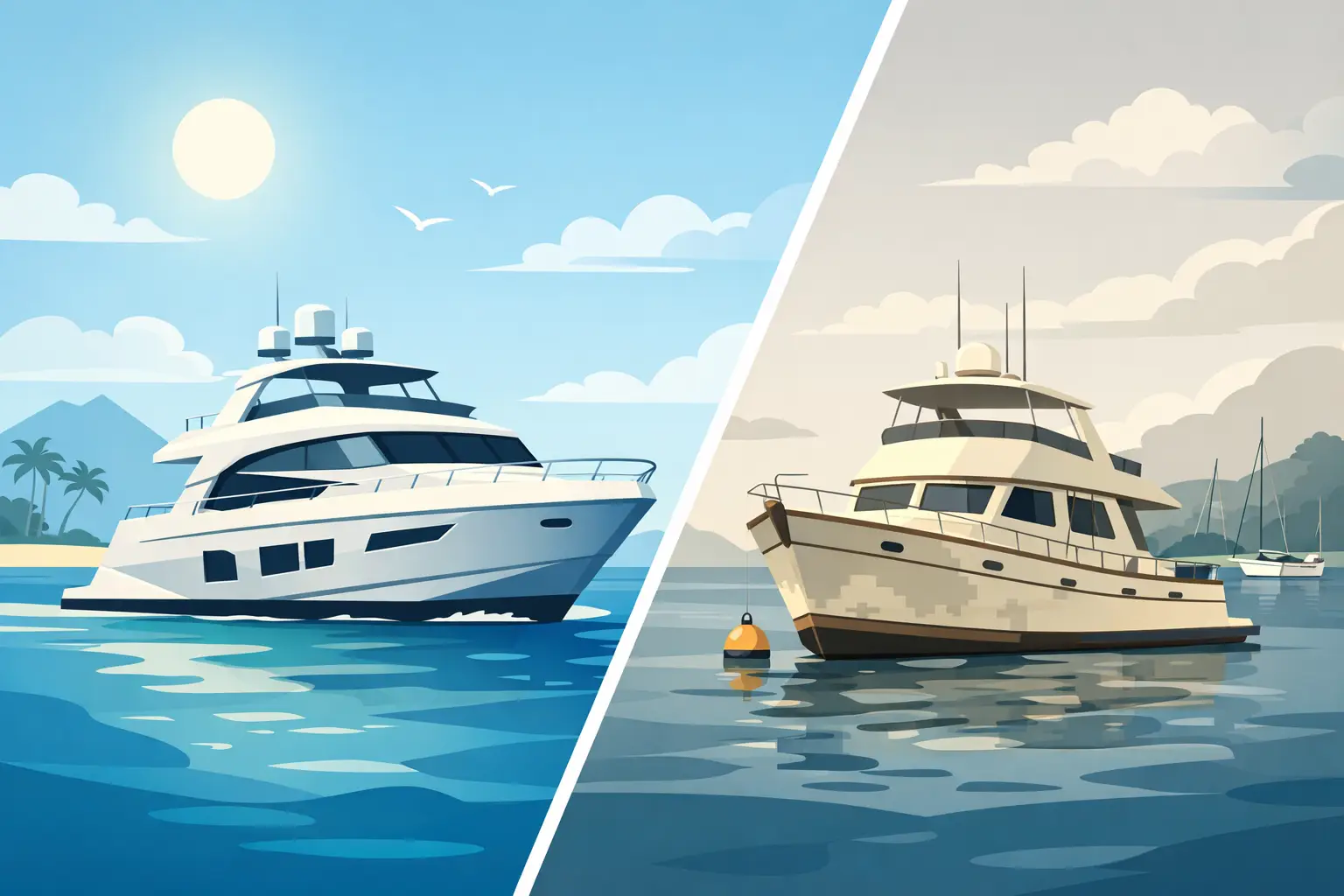
A buyer may spend months studying layouts, range, brand pedigree, and crew flow, only to find that the real decision arrives much earlier: new yacht vs used yacht. That choice shapes not only capital outlay, but also delivery timing, depreciation, maintenance exposure, customization options, and resale strategy. For serious buyers, it is less about romance and more about fit.
In the East Mediterranean especially, where seasonal timing, cruising plans, and cross-border transactions can quickly affect opportunity, the right purchase path depends on how you intend to use the yacht and how much complexity you are prepared to absorb. A beautiful vessel can still be the wrong asset if the ownership profile does not match your priorities.
New yacht vs used yacht: the real difference
On paper, the comparison appears simple. A new yacht offers a clean technical baseline, current design, modern systems, builder warranties, and the pleasure of being first owner. A used yacht may offer more volume, stronger value per foot, immediate availability, and a known maintenance history.
In practice, buyers are comparing certainty in different forms. With a new build or recently delivered unsold yacht, you are buying design freshness and reduced wear, but you are also accepting a premium price and, in many cases, waiting time. With a pre-owned yacht, you may gain substantial value and faster access to the water, but due diligence becomes far more important. Survey quality, refit records, machinery hours, class status, cosmetic condition, and ownership history all matter.
That is why this decision is rarely about whether one option is universally better. It is about where you want risk, where you want flexibility, and how disciplined you are about long-term ownership costs.
When a new yacht makes the most sense
A new yacht is often the right choice for buyers who have a very specific vision. If your priorities include custom interior finishes, preferred naval architecture, updated stabilizer systems, lower emissions, advanced AV/IT integration, or a bespoke owner layout, starting new gives you control that the brokerage market cannot always provide.
There is also a financial logic to buying new, despite the higher headline price. Early ownership typically brings fewer immediate surprises in terms of deferred maintenance. Engines, generators, electronics, air conditioning, watermakers, and hotel systems begin life on your schedule, not someone else’s. For owners who want predictable early-year use, that matters.
New yachts also appeal to buyers who see the vessel as an extension of personal identity or family lifestyle. The appeal is not simply that everything is unused. It is that the yacht can be commissioned around the way you actually cruise, entertain, and travel.
Still, this route has trade-offs. The first is depreciation. Much like luxury automobiles, many new yachts see the sharpest value correction in the first ownership cycle. The second is time. If the yacht is under construction or built to order, delivery schedules can stretch, and delays are not unheard of. The third is that customization, while attractive, can become expensive quickly and may not always support future resale if choices are overly personal.
When a used yacht is the smarter buy
For many informed buyers, the brokerage market presents the more compelling case. A used yacht can offer significantly more yacht for the same capital. That may mean stepping into a higher pedigree shipyard, a larger length category, a better guest arrangement, or a model with proven seakeeping and charter appeal.
A well-maintained pre-owned yacht may also come with advantages a new yacht cannot. The vessel may have already completed the expensive and inconvenient shakedown period. Early technical issues may have been identified and corrected. Equipment upgrades may already be installed. In some cases, a recent refit can leave a yacht presenting at a very high standard without the premium attached to new delivery.
Timing is another major factor. Buyers who want to use the yacht this season are often better served by quality brokerage inventory. Waiting for a build slot is sensible only if the timetable suits your life. If your plan involves immediate cruising in Greece, the South of France, Italy, or Turkey, availability matters as much as specification.
Of course, used does not automatically mean value. A yacht priced attractively may be hiding expensive future liabilities. Main engine overhauls, paintwork, teak replacement, stabilizer service, electronics renewal, or interior updates can materially change the true acquisition cost. A disciplined pre-purchase process is what turns a used yacht into a smart purchase instead of an expensive correction.
Cost is more than purchase price
This is where many comparisons become too simplistic. The initial number is important, but ownership economics tell the fuller story.
A new yacht generally demands more capital at entry, plus taxes, registration, legal structuring, and delivery expenses. However, near-term maintenance may be lower, and the yacht may require less cosmetic or technical intervention in the first years. Insurance terms can also be more straightforward depending on build and use profile.
A used yacht may look attractive on acquisition, but the budget should include survey findings, immediate works after completion, and realistic annual upkeep. If the yacht needs electronics modernization, soft goods renewal, a machinery catch-up program, or a partial refit to reflect your standards, the spread between new and used can narrow.
That said, a carefully selected brokerage yacht often remains the stronger value proposition because much of the initial depreciation has already occurred. Buyers focused on preserving capital often prefer this route, provided the technical fundamentals are sound.
Customization vs convenience
One of the clearest dividing lines in the new yacht vs used yacht decision is whether you value personalization more than immediacy.
New construction allows you to shape the yacht around your tastes and intended use. You can choose materials, finishes, galley configuration, crew circulation, exterior deck furniture, tender arrangements, and technical options. For owners with clear preferences, that control is meaningful.
Used yachts offer a different luxury: convenience. You can inspect the exact vessel, review its service file, understand how spaces feel in reality, and take delivery without waiting through design meetings and production milestones. For many buyers, especially those who have owned before, this directness is more valuable than selecting every detail from scratch.
There is also a middle ground. A strong brokerage purchase followed by a focused refit can produce an excellent result. Instead of paying the premium for brand-new delivery, some buyers acquire a well-built pre-owned platform and invest selectively in cosmetics, technology, and owner-facing areas. Done properly, this can be both financially and operationally intelligent.
How experienced buyers assess risk
Experienced yacht buyers rarely ask only, “Which one is better?” They ask, “Which one is more suitable for the next five years?”
If your priority is low-friction ownership, family use, and a modern onboard experience with minimal early intervention, new may justify its premium. If your priority is value, immediate cruising, and asset efficiency, used may be the stronger route.
They also consider exit strategy. Some yachts hold value better because of shipyard reputation, layout, volume, crew practicality, and market demand. A new yacht with highly individualized specifications may be harder to place later. A used yacht from a respected builder with broad appeal may sell more efficiently, particularly if purchased at the right level and maintained carefully.
This is where professional representation matters. The right broker does more than present inventory. They help interpret technical records, benchmark asking prices, coordinate surveyors and legal advisers, manage negotiation, and identify whether a yacht suits your ownership pattern rather than simply your first impression. For buyers entering the East Med market, that guidance can reduce both cost and noise.
New yacht vs used yacht: which buyer are you?
If you want a yacht that reflects your exact preferences, can accept a longer timeline, and are comfortable paying for first ownership, new may be the right fit. If you want stronger value, faster access, and the ability to buy into a proven yacht with mature service history, used is often the more strategic purchase.
The best decisions are usually made by buyers who are honest about how they will actually use the vessel. Weekend island hopping has different demands than long-range family cruising, charter deployment, or formal entertaining. So does your tolerance for project management after purchase.
At AlphaOceanic, that conversation is often where the real work begins. Not with a listing, but with a clear understanding of what the owner wants the yacht to do.
A fine yacht can be found in either category. The better outcome comes from choosing the one that matches your timing, expectations, and appetite for ownership complexity, then buying it with discipline.