

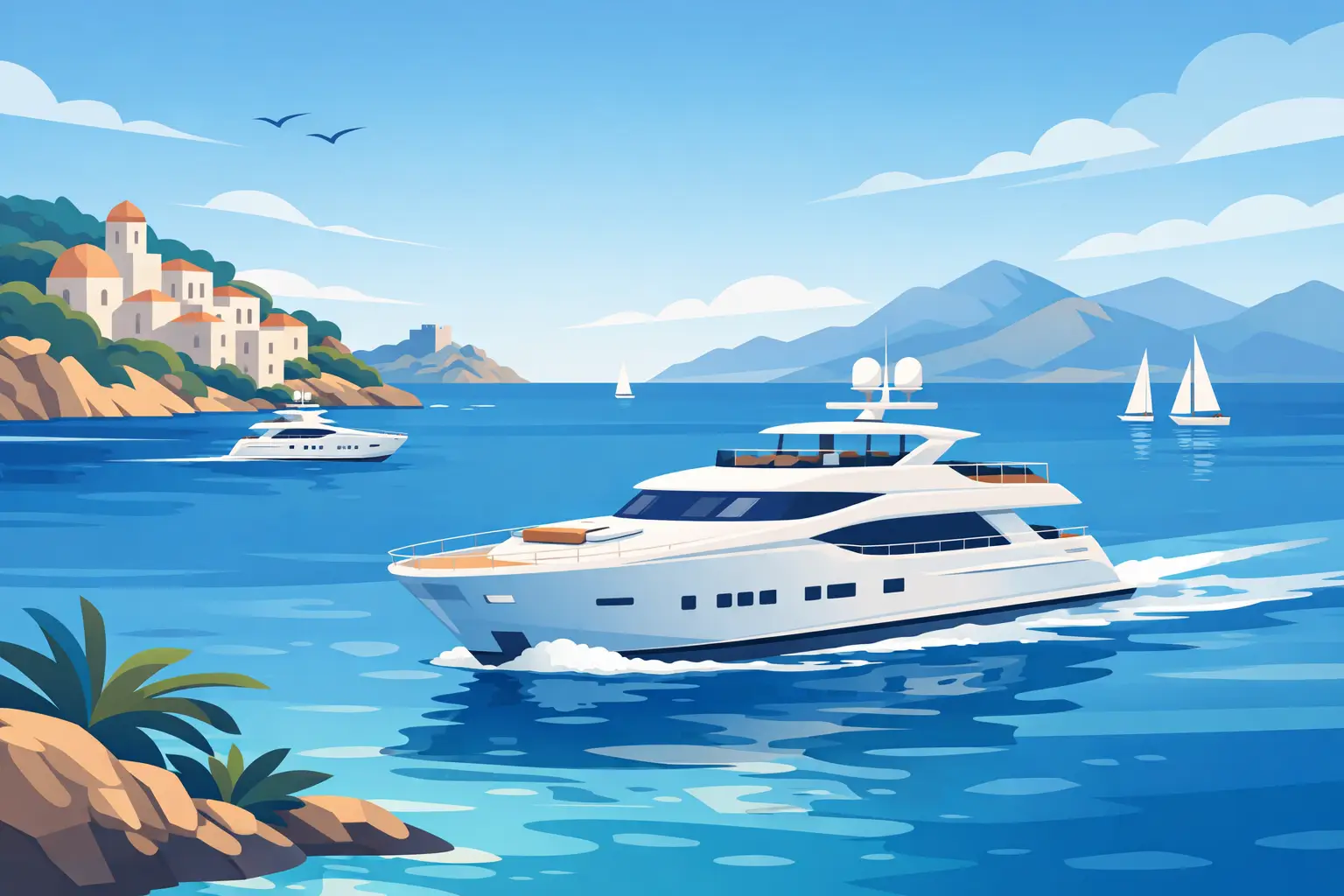
A yacht that feels perfect in South Florida or the Caribbean can be the wrong answer for the Cyclades, the Ionian, or the Croatian coast. The best yachts for Mediterranean cruising are not defined by length alone, or by brand prestige, or by top speed. They are defined by how well they suit the region’s realities – short coastal passages, busy summer marinas, changeable meltemi winds, warm-weather living, and an owner’s preferred style of use.
For serious buyers, that distinction matters. In the Mediterranean, the right yacht is as much about lifestyle geometry as it is about specifications. Deck flow, draft, stabilization, tender stowage, crew circulation, and air conditioning capacity can have more bearing on enjoyment than an extra two knots of speed.
What makes the best yachts for Mediterranean cruising
Mediterranean cruising tends to reward a specific set of characteristics. Owners usually move between islands, anchor in clear water close to shore, entertain outdoors, and spend long hours on deck. That makes exterior living space a genuine priority, not a marketing line.
A successful Med yacht typically combines generous aft deck seating, a practical swim platform, easy tender access, and a flybridge or sun deck that is usable throughout the day. Shade is not optional. Neither is efficient cooling below deck. Equally, maneuverability is important because stern-to mooring in compact harbors remains part of the experience in many destinations.
Draft also deserves more attention than many buyers initially give it. Some larger yachts are entirely suitable for the Mediterranean, but excessive draft can limit options in shallower bays and more informal anchorages. Range, by contrast, matters differently here than in ocean-crossing scenarios. You do not necessarily need extreme fuel capacity, but you do want efficient cruising performance and the flexibility to move comfortably between destinations without planning every stop around bunkering.
Motor yachts: often the natural fit for the Med
For many owners, a motor yacht remains the clearest answer. Mediterranean cruising often involves compressed itineraries, guests coming and going, and a preference for reaching a lunch anchorage or evening port with speed and comfort. A well-chosen motor yacht supports that rhythm exceptionally well.
The strongest candidates are usually in the 60 to 100 foot range, where the balance between interior volume, crew capability, and marina access is still favorable. Below that, owner-operator options become more practical. Above that, onboard comfort rises considerably, but so do berth limitations, operating costs, and seasonal logistics.
Flybridge yachts
A flybridge yacht is one of the most versatile choices in the region. It offers elevated visibility, excellent outdoor entertaining space, and distinct social zones that work well for families or mixed guest groups. In the East Mediterranean especially, where long afternoons at anchor are part of the appeal, a flybridge quickly becomes the focal point of daily life.
The trade-off is profile height and, in some models, a greater emphasis on volume over elegant hull efficiency. Not every flybridge design handles spirited sea conditions with the same composure. That is why hull pedigree, stabilization, and weight distribution deserve close scrutiny.
Open and sport yachts
Open yachts and sport cruisers have long been associated with Mediterranean glamour, and for good reason. They are fast, stylish, and perfectly suited to coastal hops between beach clubs, islands, and resort marinas. For owners who prioritize day use, spontaneous entertaining, and visual impact, they remain compelling.
But they are not ideal for every buyer. Exterior living is excellent, yet interior volume can be tighter, and sun exposure is greater. They suit couples, smaller groups, or owners with a strong preference for performance. For extended family cruising over several weeks, many buyers eventually lean back toward enclosed salons, better crew separation, and more practical storage.
Explorer-style motor yachts
Explorer yachts have become more visible in the brokerage market, and some are highly attractive for Mediterranean use. Their appeal lies in solid sea-keeping, larger tankage, strong toy-carrying capability, and a more relaxed long-range platform. They are especially well suited to owners who want to combine the Mediterranean with broader seasonal cruising.
Still, not every explorer-style yacht is the best fit for classic summer Med living. Some trade away the openness and sleek deck arrangement that this region rewards. If your cruising calendar is centered on Greece, southern Italy, Turkey, or the French Riviera, an explorer can work brilliantly, but only if its outdoor spaces are genuinely inviting rather than merely functional.
Sailing yachts: the purist’s Mediterranean choice
There is still a strong case for sail in the Mediterranean, particularly for owners who value the passage itself as much as the destination. A sailing yacht offers a more tactile, elegant, and often quieter connection to the sea. In regions where afternoon winds build predictably, the experience can be exceptional.
The best sailing yachts for Mediterranean cruising usually combine manageable sail plans with comfortable deck movement and strong anchoring capability. Center cockpit arrangements, generous cockpit shading, and practical access to the water are particularly valuable. Below deck, ventilation matters just as much as finish quality.
Performance cruisers
For experienced owners, a performance cruiser can be one of the most rewarding platforms in the region. It delivers genuine sailing pleasure while retaining enough comfort for family use. These yachts suit buyers who know they will actually sail, not simply admire the rig from the quay.
The caution is simple: performance often brings compromises in interior volume, crew accommodation, or forgiving handling. If guests are inexperienced or if the program includes frequent charter-style entertaining, a more moderate cruiser may be the wiser choice.
Bluewater cruising sailboats
A bluewater sailing yacht can be highly suitable in the Mediterranean, particularly for owners planning shoulder-season passages or broader regional movement. Strong construction, tankage, and comfort underway all count in its favor.
Yet there is an important distinction between capable and convenient. Some bluewater designs are optimized for ocean passages rather than marina life and warm-weather social use. Heavier displacement, darker interiors, and more conservative deck layouts can feel less aligned with a summer Mediterranean program.
Size matters, but only in context
Buyers often ask for a minimum length before defining how they will actually cruise. In practice, the ideal size depends on who is coming aboard, where the yacht will be based, and whether the owner prefers privacy at anchor or energy in established ports.
For couples or small families, the sweet spot often sits between 55 and 75 feet. At this size, you can access a broad mix of marinas, keep operational complexity under control, and still enjoy serious comfort. For larger families, regular guest use, or crewed operation, 80 to 100 feet opens a more luxurious standard of accommodation and service.
Beyond 100 feet, the experience becomes unmistakably more grand, but also more selective. Berth availability narrows in peak season, Mediterranean port planning becomes less flexible, and support requirements rise. That does not make larger yachts unsuitable. It simply means the ownership model must be intentional.
The features worth paying for
When evaluating the best yachts for Mediterranean cruising, certain features consistently justify their premium. Stabilizers are near the top of the list, particularly for comfort at anchor. A hydraulic swim platform is another, because access to the water defines so much of the region’s appeal.
A proper hardtop, well-planned crew quarters, a capable watermaker, and dependable air conditioning also have real value. Tender storage should be considered early, not late. Many buyers focus on the main yacht and underestimate how central the tender is to everyday Med use, especially in roadless bays or where shore transfer is part of dinner plans.
On pre-owned yachts, refit history matters as much as original pedigree. A respected builder with outdated systems, tired exterior spaces, or underpowered climate control may be less attractive than a slightly less famous yacht that has been intelligently upgraded. In brokerage, condition and ownership history often tell the more useful story.
Choosing the right yacht means choosing the right program
The real question is not which brand builds the best yacht for the Mediterranean. It is which yacht best suits your style of ownership. An owner focused on island-hopping with family has different priorities from one who entertains business guests in Mykonos, and both differ from a buyer planning extended cruising between Greece, Italy, and the Adriatic.
That is where disciplined brokerage guidance becomes valuable. The strongest acquisitions are rarely the ones that looked best in photographs. They are the ones where layout, technical condition, operating profile, and cruising geography align. For buyers entering the East Mediterranean market, that alignment is especially important because inventory can be fragmented and vessel suitability is not always obvious from a listing alone.
At AlphaOceanic, that conversation begins with how you intend to use the yacht, not with a generic shortlist. It is a more precise way to buy, and for this market, it is usually the right one.
The Mediterranean rewards yachts that feel effortless once the lines are cast off. If a vessel lets you move easily, anchor well, host comfortably, and enjoy the sea without compromise, you are already much closer to the right answer.