

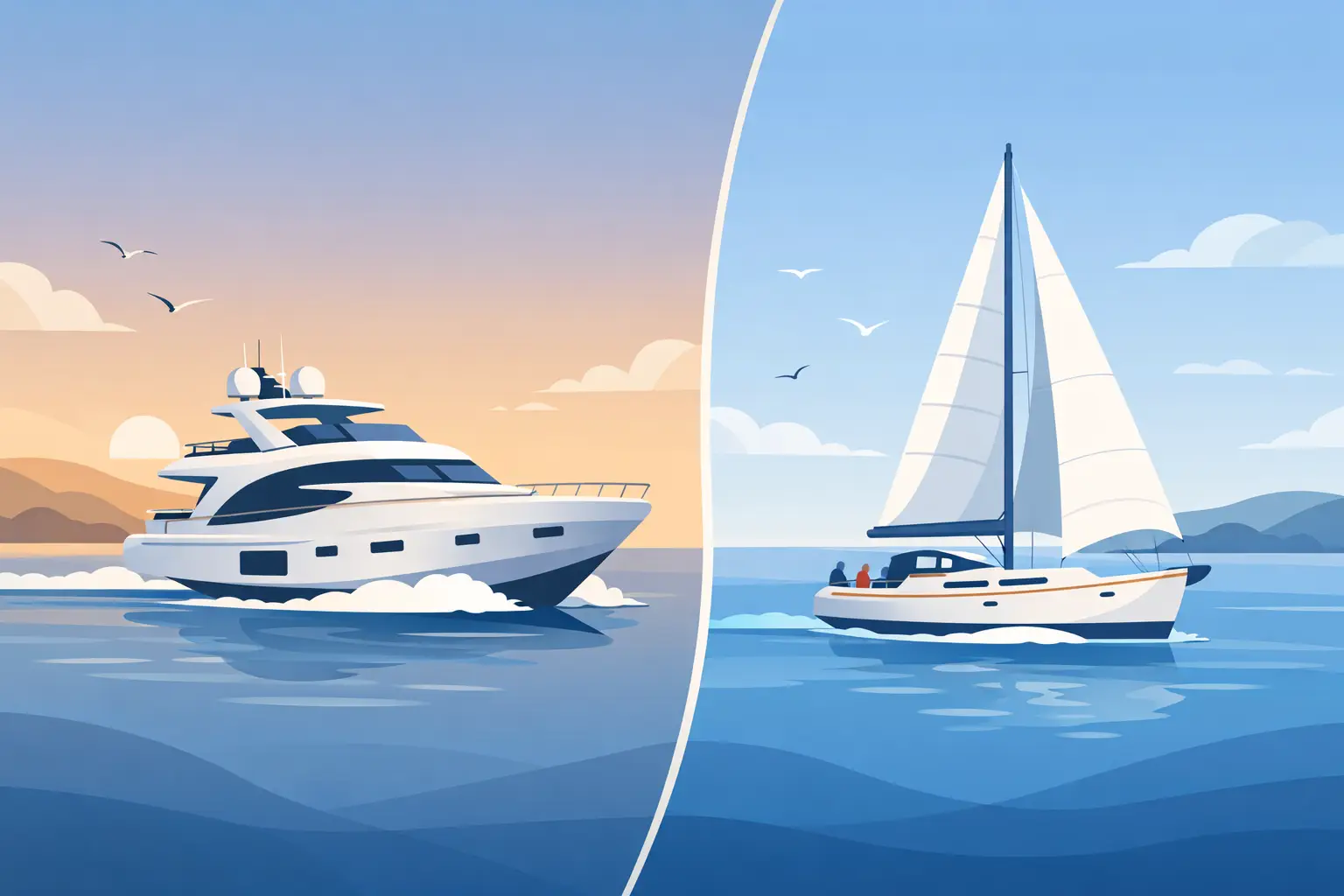
Choosing between a motor yacht vs sailing yacht is rarely about romance alone. Buyers often arrive with a clear image in mind – fast island-hopping with effortless comfort, or a quieter, more traditional experience under sail – but the right decision usually comes down to how you truly intend to use the yacht, who will be on board, and how you want ownership to feel over time.
For experienced buyers, this is not a lifestyle quiz. It is an asset decision with operational, technical, and resale consequences. The better choice is the one that aligns with your cruising grounds, guest profile, crew expectations, and tolerance for maintenance, not simply the one that photographs best in port.
Motor yacht vs sailing yacht: the real difference
At a glance, the distinction seems obvious. A motor yacht prioritizes engine-powered performance, interior volume, and convenience. A sailing yacht brings a different kind of engagement, where passage-making is shaped by wind, sail plan, and a more active relationship with the sea.
In practice, the ownership experience differs more than many first-time buyers expect. A motor yacht generally delivers speed, predictable routing, larger social spaces, and straightforward maneuvering with the right systems on board. A sailing yacht often offers lower fuel burn under sail, a more elegant profile, and a form of cruising that appeals to owners who value the journey as much as the destination.
Neither is inherently superior. The question is what standard of use you expect, and what compromises you are willing to accept.
Speed, range, and itinerary planning
If your priority is covering distance quickly and keeping a fixed schedule, the motor yacht usually has the advantage. In the East Mediterranean especially, where owners may wish to move efficiently between Athens, the Cyclades, the Ionian, or onward to Turkey and Croatia, speed changes the entire rhythm of a season. A motor yacht allows shorter travel times, easier day planning, and more flexibility when guests are arriving with limited vacation windows.
That convenience comes at a cost. Higher cruising speeds generally mean greater fuel consumption and, depending on the yacht, more significant engine maintenance obligations. Range must also be considered carefully. Some motor yachts are optimized for performance and comfort rather than long-distance efficiency, so tankage, engine hours, and intended use matter greatly in the buying process.
A sailing yacht tends to reward owners who are less rigid about the clock. Under favorable conditions, sailing can be deeply satisfying and surprisingly efficient, but your routing remains more dependent on weather, wind angles, and crew capability. For owners who enjoy passage planning and do not mind adjusting around conditions, this is part of the appeal. For those managing family schedules or entertaining guests with little patience for delay, it may become a limitation.
Comfort on board and use of space
Comfort means different things to different buyers. On a motor yacht, comfort often comes in the form of volume. Wider beams, generous saloons, larger flybridges, substantial sun pads, and easier guest circulation make motor yachts particularly attractive for entertaining. They often feel more like private waterfront residences, with layouts designed for long lunches, overnight hosting, and multigenerational use.
This matters for buyers who plan to spend extended periods on board with family, business guests, or charter-style social patterns. The easier the yacht is to inhabit, the more often it tends to be used.
A sailing yacht offers a different kind of comfort. The interior can feel warm, refined, and highly sophisticated, but volume is usually more limited at a comparable length. Deck layouts are shaped by sailing function, so open lounging areas may be less expansive. Movement on board can also be more dynamic while underway, particularly in stronger conditions.
That said, many discerning owners value the atmosphere of a sailing yacht precisely because it feels more purposeful and intimate. For couples, experienced yachtsmen, and buyers who favor elegance over excess, that distinction can be a major advantage rather than a drawback.
Stability and guest experience
Guest comfort deserves honest attention. A motor yacht offers stable, predictable cruising in many conditions, particularly with stabilizers at anchor and underway. This can make a meaningful difference for less experienced guests or families with children.
A sailing yacht can provide a remarkably smooth and quiet passage under the right conditions, but heel angle and sail movement are not for everyone. Some owners love that sensory connection. Others discover that their guests do not.
Crew, handling, and owner involvement
One of the most overlooked parts of the motor yacht vs sailing yacht decision is how involved the owner wants to be. A motor yacht often lends itself to relatively simple operation at certain sizes, particularly with modern navigation systems, thrusters, and well-designed helm controls. Of course, complexity rises quickly as size and equipment increase, but many buyers are drawn to the ease of command and predictable handling.
Sailing yachts ask more of the owner, or more of the crew. Sail handling systems have become increasingly sophisticated, but trimming, weather awareness, rig inspection, and maneuvering under sail still require knowledge and attention. For some owners, this is exactly the point. They want an active role in the yacht rather than a purely hospitality-led experience.
Crew profile also differs. On larger motor yachts, hospitality and engineering support may carry greater weight. On sailing yachts, especially performance-oriented examples, seamanship and sail expertise become central. When assessing a pre-owned yacht, buyers should consider not only current manning levels but also the ease of recruiting and retaining the right crew for that specific vessel.
Operating costs and technical maintenance
There is no serious yacht purchase without a clear view of annual running costs. Motor yachts typically involve higher fuel expenditure, and engine-driven systems can create a larger service burden depending on age, machinery specification, and usage pattern. Major overhauls, generator service, air conditioning loads, and hotel systems all factor into the ownership picture.
Sailing yachts may reduce fuel consumption significantly when used properly, but they are not low-maintenance assets. Standing rigging, running rigging, sails, winches, furling systems, mast inspections, and sail-drive or auxiliary engine service all require disciplined oversight. A neglected rig can be as costly and consequential as neglected machinery.
The right comparison is not simply fuel versus sails. It is total ownership profile. A well-maintained sailing yacht may offer very sensible long-term value for the right owner, while a properly specified motor yacht may justify higher annual costs through greater usability and broader family appeal.
Resale, market demand, and buyer profile
Resale should never be the only reason to buy a yacht, but it should be part of the conversation from day one. Motor yachts generally appeal to a wider buyer pool, particularly in segments where comfort, speed, and guest accommodation drive demand. This can support liquidity in the resale market, provided the yacht has strong maintenance records, credible specification, and sensible pricing.
Sailing yachts can command exceptional loyalty among informed buyers, but the market is often narrower and more specialized. Design pedigree, rig configuration, shipyard reputation, and condition have an outsized influence on value. A sailing yacht with the right story and proper technical care can perform very well on resale. One with deferred maintenance will often struggle.
This is where tailored brokerage guidance becomes particularly valuable. In a fragmented international market, the difference between a broadly visible yacht and a properly positioned yacht is significant. AlphaOceanic approaches these decisions with the discretion, market reach, and transaction discipline that high-value yacht sales demand.
Which yacht suits which owner?
If your season is built around efficient movement, comfort at anchor, entertaining, and making the most of limited leisure time, a motor yacht often proves the more natural fit. It favors owners who want convenience, larger social spaces, and a controlled, predictable onboard experience.
If you value the mechanics of true seamanship, the quiet satisfaction of passage-making under sail, and a closer relationship with the water, a sailing yacht may be the better choice. It tends to suit buyers who enjoy the process as much as the arrival.
There are, of course, edge cases. Some owners adore sailing but primarily host non-sailing guests. Others want a motor yacht for family use today while keeping an eye on future resale and charter appeal. Some buyers simply respond to the design language of one category more than the other, and that matters too. A yacht is a technical purchase, but it is also a personal one.
The best decision starts with honest use cases
Before comparing brands, lengths, or price points, define the ownership pattern with precision. How many guests will realistically sleep on board? Will your cruising be weekend-based or seasonal? Are you planning owner-operation, a captain-led program, or full crew? Do you want to arrive quickly, or do you want the passage itself to be the reason for going?
These questions tend to reveal the answer faster than any specification sheet. The right yacht is not the one that promises everything. It is the one that fits your life so well that using it feels natural from the first season onward.
A refined purchase begins when preference gives way to clarity. Once you know how you want to live on the water, the right yacht category usually becomes obvious.